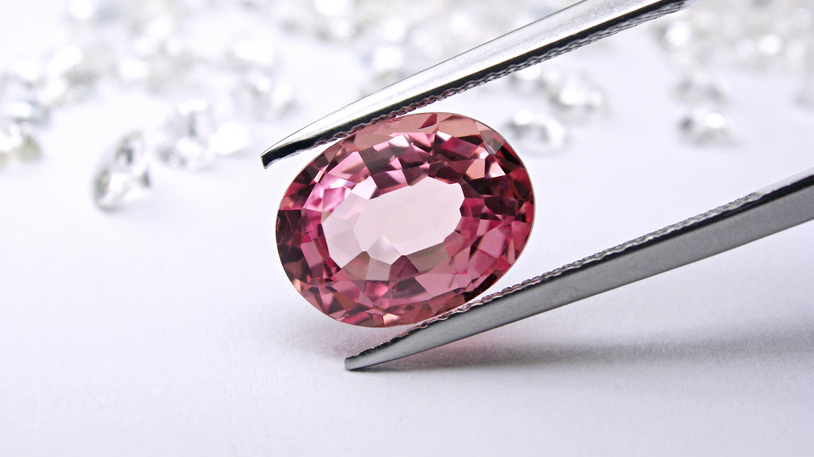
Cut Quality

Just like carat weight, clarity, and color, cut quality is vital in driving the diamond’s value.
A polished diamond is cut from a rough gemstone. Contrary to popular opinion, the practice of gem cutting did not in fact appear in ancient times. The first attempts to take the chisel to the world’s most resilient mineral were made not that long ago, in the 14th century, and the first diamond cuts were very simple.
It was not until the last century that diamond cutters managed to mathematically calculate the ideal cut proportions for maximum radiance and light reflection. In 1919, the young mathematician Marcel Tolkowsky, scientifically proved that the ideal diamond shape would be a round cut with 33 facets at the top and 24 at the bottom. This 57-faceted round cut still remains a classic.
Nevertheless, there are many other kinds of diamond cuts, which are sometimes referred to as «fancy» cuts, such as: the Trigon, the Pear, the Marquise, the Heart, the Baguette, the Emerald, the Oval, the Princess, and many others.
The most widespread system for appraising the diamond’s cut quality was designed by the Gemological Institute of America (GIA). This system accounts for three criteria: gem proportions, symmetry, and finish grade quality. Each criterion has a five-level rating scale, ranging from Poor (P) to Excellent (X). That is why, for instance, the best possible cut score is Triple Excellent (excellent rating across all three criteria).
Finally, it’s worth noting that ALROSA is currently the world’s only diamond mining company that has its own gem polishing facility. The experts at DIAMONDS ALROSA carefully preserve the unique classical traditions of Russian diamond cutting, which are highly regarded around the world. We use the best equipment, which helps us create high-quality polished diamonds. It was the expert cutters at DIAMONDS ALROSA that worked on Russia’s most expensive polished diamond: the 51.38-carat Dynasty gem, which scored the highest for its cut quality.
Related articles